How to Play Baccarat: Rules, Odds and the Only Bet Worth Making
Baccarat is the game casinos reserve their most theatrical rooms for, and underneath the velvet rope it is close to a coin flip. You bet on one of three outcomes, Banker, Player or Tie, the cards play themselves out by fixed rules, and no decision you make after placing the bet changes anything.
That is not a criticism. It makes baccarat the easiest table game to play correctly, because playing correctly is a single choice made before the first card is dealt. This guide covers the rules, the real odds behind each bet, and the one piece of strategy that actually holds up.
1.06%House edge on the banker bet8Decks in the shoe0Decisions after the deal
How to Play Baccarat: The Basics
Two hands are dealt from a shoe of usually eight decks: one to the Player position, one to the Banker position. Neither hand belongs to you; they are just the two sides of the bet. Whichever hand finishes closer to nine wins.
Card values take one hand to learn. Tens, jacks, queens and kings count zero, aces count one, everything else counts its face value, and only the last digit of the total matters. A seven and an eight make fifteen, which counts as five. There is no busting in baccarat; totals simply wrap around.
Where to Play Baccarat for Real Money
Baccarat asks nothing of you beyond picking a side, which makes the choice of casino unusually simple: you want a live table with a commission structure that has not been quietly modified, and you want the table minimum to suit you rather than the room.
These are the licensed casinos we have reviewed, by region, with what each one offers at the baccarat table.
Asia licenses less online casino play than any other region on this page, so read the market column before anything else. The Philippines is the clear exception: PAGCOR licenses domestic play through its Electronic Gaming Licensing Department, and since the offshore POGO regime was abolished outright a site reachable from inside the country is legal only with a domestic licence and a verifiable PAGCOR seal. The PIGO operators above are integrated resorts, which means their games run on real tables and machines inside the building rather than on a software server. Georgia and Armenia are Western Asia geographically and are licensed by the Revenue Service of Georgia — note that Georgian citizens must be 25, while visiting foreign nationals may play from 18. Most of the rest of the region licenses nothing: India banned real-money online gaming outright in 2025, and China, Indonesia, Vietnam, Thailand, Japan and South Korea all prohibit or heavily restrict online casino play for residents.
*Bonus figures are indicative and change often — always confirm the current offer and the full T&Cs on the operator’s own site. Minimum age 18–25 depending on jurisdiction — 21 across the United States and the Philippines, and 25 for Georgian citizens. Play only where it’s legal for you, and only what you can afford to lose — support is at BeGambleAware.org and your local helpline.
The Third-Card Rules Run Themselves
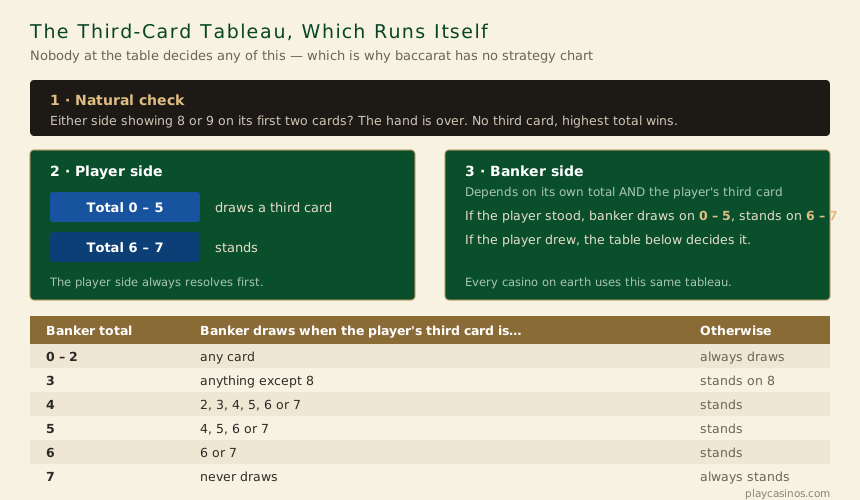
Each side starts with two cards. A total of eight or nine is a “natural” and ends the hand immediately. Otherwise the Player side draws a third card on a total of five or less, and the Banker side draws according to a fixed tableau that weighs its own total against the Player’s third card.
You never need to memorize that tableau. The dealer applies it automatically, the same way at every table on earth, which is exactly why baccarat has no equivalent of a blackjack strategy chart. There is nothing to decide mid-hand.
The tableau every casino uses. Nobody at the table decides any of it.
Banker, Player or Tie: The Real Odds
Over the long run with eight decks, the Banker hand wins about 45.9% of hands, the Player hand about 44.6%, and roughly 9.5% end in a tie. Because the Banker side wins more often, winning Banker bets pay a 5% commission; even after the commission, Banker remains the better bet.
Bet
Pays
House edge
RTP
Banker
1:1 minus 5% commission
1.06%
98.94%
Player
1:1
1.24%
98.76%
Tie
8:1
14.36%
85.64%
Those Banker and Player numbers are the reason baccarat sits near the top of our RTP and house-edge database, in the same neighborhood as blackjack played with perfect strategy, and with none of the homework.
Why the Tie Bet Is a Trap
The Tie pays 8:1, which sounds generous until you set it against the true odds of about 9.5 ties in 100 hands. The gap between the payout and the reality works out to a house edge over 14%, roughly thirteen times worse than the Banker bet on the same felt.
Casinos display it prominently for a reason. Skip it, every time, and treat any scoreboard pattern suggesting a tie is “due” as decoration.
Why the Tie Is a Trap
the arithmetic behind the worst bet on the felt
It pays 8:1. Generous-sounding, and that is the point.
It lands about 9.5% of the time. Fair odds would be roughly 9.5:1.
The gap is the house’s. 14.36% of every tie bet, against 1.06% on banker.
No scoreboard changes this. A tie is never ‘due’ — the shoe has no memory.
Mini-Baccarat, the Big Table and the Squeeze
Mini-baccarat is the same game at a smaller, faster table where the dealer handles all cards; it is where most baccarat is actually played, and the odds are identical. The full-size table adds ceremony: players take turns handling the shoe, and in high-limit rooms the “squeeze”, slowly peeling up the corner of the deciding card, is the whole show. Macau’s casinos, which earn the large majority of their table revenue from baccarat, run entire floors this way.
The game’s older ancestor, chemin de fer, is the version Ian Fleming put James Bond across the table at in Casino Royale in 1953; in that variant players genuinely bank against each other. Punto banco, the version in every modern casino, replaced those decisions with the fixed tableau above. Some tables also market “no commission” baccarat, where a winning Banker hand totalling six pays half; the branding varies, the math is slightly worse than classic Banker.
The Three Baccarat Versions Still in Play
The odds you have just read apply to punto banco, which is what almost every casino means when it says baccarat. Two older relatives are still dealt, and one of them plays by genuinely different rules.
Punto Banco
Banker 1.06% · Player 1.24%
The standard game and the one every figure on this page describes. Three dealers, a full-size table, and a fixed tableau that decides every third card for you. Nobody at the table makes a decision after the bet is placed.
Fixed drawing rules, no player choices
5% commission on winning Banker bets
Players take turns handling the shoe in the big-table version
The default, and correctly so. Bet Banker, ignore the scorecard they hand you.
Chemin de Fer
Commission on the bank, not the bet
The ancestor, and still dealt in parts of France. One player takes the bank and covers the other players’ wagers with their own money; the house merely runs the table and takes a cut. Both sides get a real decision on the third card.
Players bank against each other, not against the casino
Standing on 5 is a genuine judgement call
The version Ian Fleming put James Bond behind in 1953
Rare, slow and the only baccarat with actual skill in it. Play it if you find it.
Mini-Baccarat
Identical odds, triple the speed
The same game on a smaller table with one dealer handling every card. Lower minimums, no ceremony, and the format where the overwhelming majority of baccarat is actually played today, both in casinos and online.
Same 1.06% Banker edge as the big table
Up to 150 hands an hour against roughly 40
Table minimums often a tenth of the high-limit room
The odds are identical and the hourly cost is not. Speed is the hidden price here.
That last point deserves more than a card. House edge is a rate, and rates need a denominator. A 1.06% edge on 40 hands an hour at €100 a hand costs about €42; the same edge on 150 hands at the same stake costs €159. Mini-baccarat is not a worse bet than the big table, it is the same bet charged three times as often, and online tables run faster still.
Then there is no-commission baccarat, marketed under a dozen names. It removes the 5% cut on Banker wins and pays only half on a winning Banker total of six. That single exception pushes the Banker edge from 1.06% to about 1.46%, which is worse than the Player bet you were told to avoid. The commission was never the problem.
Baccarat Strategy: What Actually Helps
Honest baccarat strategy fits in three lines. Bet Banker, because 1.06% is the best number on the table. Ignore the derived roads and bead plates on the scoreboard; every hand is independent, and no streak changes the next card. Never chase losses with doubling systems, since a Martingale run into a table limit converts a small edge into a large hole.
What remains is bankroll discipline: decide the session amount before you sit down, and count the 5% commission as part of the cost of the best bet rather than a reason to switch to Player. If you want a decision-rich card game instead, that is what blackjack is for.
Banker vs player over 100 hands
Outcome
Frequency
What it means for your bet
Banker wins
about 45.9%
Paid 1:1 less 5% commission
Player wins
about 44.6%
Paid 1:1, no commission
Tie
about 9.5%
Banker and player bets push
Banker wins more often than player. The commission exists precisely because of that gap.
Play Baccarat Free: The Practice Table
The table below deals real punto banco hands: back Banker, Player or Tie, press Deal, and the third-card rules resolve the hand exactly as a live dealer would. It grades the one decision baccarat actually gives you — which side you backed.
Baccarat Questions, Answered
How do you play baccarat?
Bet on Banker, Player or Tie before the deal. Two hands are dealt by fixed rules, the one closer to nine wins, and no further decisions are involved. Tens and face cards count zero, and only the last digit of a total matters.
Should I bet on Banker or Player?
Banker. Even after the 5% commission on winning Banker bets, its house edge of 1.06% beats the Player bet’s 1.24%. The difference is small but permanent.
Why is there a commission on Banker bets?
The third-card rules favor the Banker hand, which wins about 45.9% of hands versus 44.6% for Player. Without the 5% commission, betting Banker every hand would beat the house.
What is the house edge in baccarat?
With eight decks: 1.06% on Banker, 1.24% on Player, and about 14.36% on the Tie. That makes the two main bets among the best-value wagers in the casino, and the Tie one of the worst.
Is there any skill in baccarat?
The only skill is bet selection before the deal: choosing Banker and avoiding the Tie. The draw rules are fixed, so nothing you do during a hand changes the outcome, unlike blackjack or video poker.
What is the difference between baccarat and mini-baccarat?
Speed and ceremony, not odds. Mini-baccarat uses a smaller table where the dealer handles every card; the full-size game lets players handle the shoe and squeeze cards. The rules and house edge are identical.
Do betting patterns or streaks matter in baccarat?
No. The scoreboards tracking “roads” of past results describe history, not the future; each hand is dealt from the same fixed rules regardless of what came before. Flat betting on Banker outperforms every pattern system over time.