The House Numbers
The number that actually predicts how your bankroll behaves over a long session isn’t the jackpot size, it’s the house edge, and almost no casino markets it because it’s the one number that works against you by design. This page collects the real figures, sourced from published paytables and standard rule sets, for every game on this site.
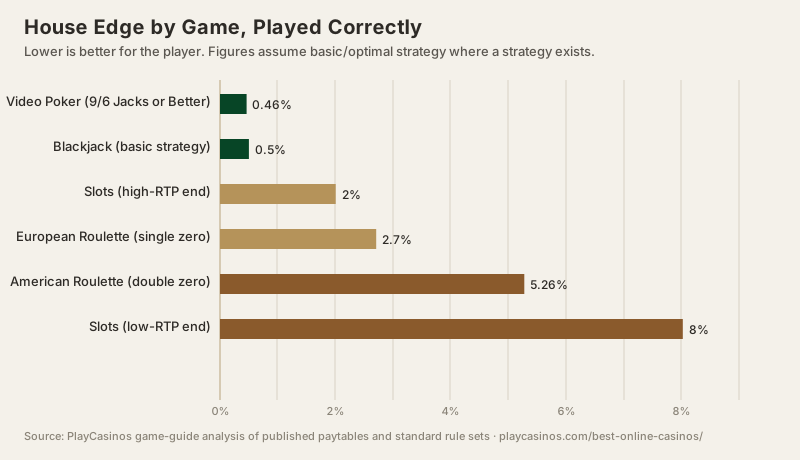
Falls as low as 0.5% when every decision follows basic strategy, one of the lowest edges of any game that doesn’t require card counting to reach.
Rule variations (dealer hits soft 17, number of decks, 6:5 blackjack payouts) can move this figure by a percentage point or more. See the blackjack guide for what to check on the felt before you sit down anywhere new.
A full-pay 9/6 Jacks or Better machine, played with correct discard strategy, edges out even blackjack. The catch is the paytable: an 8/5 short-pay machine looks nearly identical on the cabinet but carries a meaningfully worse edge. Full breakdown on the poker page.
The Banker bet keeps its 1.06% edge even after the 5% commission on wins, with the Player bet close behind at 1.24%. The Tie is the outlier at over 14%, the largest gap between two bets on a single table anywhere on this list. Full odds and third-card rules on the baccarat page.
Fixed across nearly every bet type on the wheel, since the single zero is what generates the house’s edge, not the specific number or category you back. See the roulette guide for the full bet-type breakdown.
Nearly double the European wheel’s edge, purely from the added 00 pocket. If a casino offers both wheel types, the European wheel is the better game every time.
The widest range on this page, since RTP is set by the individual game’s math model rather than a universal house rule. Reputable developers publish the figure in-game; see the slots guide for how to find it and what volatility means alongside it.
Feel free to use the house-edge chart above on your own site or in a forum post, with a link back to this page as the source.
Anything at or above 96% is respectable for a slot, and the table games sit far better still — blackjack at basic strategy returns about 99.5% and full-pay video poker 99.54%. The useful comparison is not slot against slot but slot against table: the gap between a 92% slot and a 99.5% blackjack table is the difference between an expensive evening and a cheap one.
They are the same figure from opposite ends, and they always add to 100%. A 96% RTP is a 4% house edge. Slots are quoted in RTP and table games in house edge purely by industry convention, which is why comparing the two families requires converting one of them first.
No. RTP is a long-run average measured over millions of rounds, and it says nothing about any single session. A 99% game can take your whole bankroll in an hour and a 92% game can pay a jackpot on the first spin. What RTP predicts is the cost of playing a lot, not the outcome of playing once.
Not while you are playing, and not on a whim — the configuration is certified. What an operator can do is license a different configuration of the same game from the studio, and studios routinely ship several. The figure in the game’s own information panel is the one that applies to the version in front of you.
Full-pay 9/6 Jacks or Better video poker at 0.46% to a player using correct discard strategy, then blackjack at about 0.5% on a good rule set, then the baccarat banker bet at 1.06%. All three require either a decision or a specific table; the cheap number is not the default you get by sitting down anywhere.
From paying less than true odds. A straight-up roulette bet on a single-zero wheel wins once in 37 spins but pays 35 to 1, and that two-unit shortfall is the entire 2.70%. Nothing is rigged and no outcome is manipulated — the arithmetic of the payout table does all of the work.