Casino Poker Games: Rules, Strategy and Free Play at Every Table
Poker at a casino rarely means the Texas Hold’em you watch on TV. The tables carrying the word “poker” on the main floor, Three Card Poker, Caribbean Stud, Casino Hold’em, are house-banked games: you play against the dealer’s hand or a fixed paytable, never against other players. Nobody at these tables can bluff you.
That single fact makes every game here learnable. This guide covers how to play 3 card poker, Caribbean Stud, Casino Hold’em and video poker: the rules, the right strategy and the house edge for each, plus a free trainer you can use right now. Each of these casino poker games reduces to a fixed set of correct decisions.
0.46%Best edge on the floor — 9/6 video pokerQ-6-4The whole of three card poker strategy0Bluffing, at any of these tables
What Counts as Casino Poker?
Casino poker games split into two families. Table variants like Three Card Poker, Caribbean Stud, Casino Hold’em, Ultimate Texas Hold’em and Pai Gow Poker use poker hand rankings but bank every bet against the house. Machine variants, video poker, put the same idea on a screen with a paytable instead of a dealer.
Peer-to-peer poker, the Hold’em and Omaha played in a card room against other people, is a different discipline entirely and lives outside this page. If a game pays you from the casino’s money rather than a shared pot, it belongs here.
The Three Table-Poker Games You Will Meet
Before the sections below, here is the shape of the room. Three house-banked poker games account for nearly every poker table in a licensed casino, and their house edges are far enough apart that picking the wrong one costs more than playing the right one badly.
Three Card Poker
House edge ~3.37% on ante-play
Three cards each, one decision: fold, or match your ante to see the dealer’s hand. The dealer needs queen-high to qualify, and if they miss, your ante pays and the play bet pushes.
Optimal rule: raise on Q-6-4 or better, fold everything else
Pair Plus side bet is a separate wager, edge around 7%
Fastest of the three to learn
The one to start with. One decision, one rule, and the rule fits in a sentence.
Caribbean Stud
House edge ~5.22%
Five cards each, one raise-or-fold decision, and a dealer who only qualifies with ace-king or better. When the dealer fails to qualify, your raise pushes no matter how good your hand was, which is the game’s real sting.
Raise on any pair or better, fold below ace-king
Dealer qualifies on ace-king; non-qualifying hands push your raise
Progressive side bet carries an edge above 25% on most tables
The most expensive of the three. Play it for the jackpot chase or not at all.
Casino Hold’em
House edge ~2.16%
Two hole cards, five community cards, and the familiar Texas Hold’em hand rankings, except you are playing the dealer rather than a table of opponents. The dealer qualifies with a pair of fours or better.
Call with roughly 82% of starting hands — folding is rarely right
Dealer qualifies on a pair of fours
AA bonus side bet pays on your two cards plus the flop
The best odds of the three and the most familiar rules. Start here if you know Hold’em.
Ultimate Texas Hold’em sits alongside Casino Hold’em and is the better game of the two at 2.19%, but only if you bet correctly: the 4x raise before the flop is the whole strategy, and players who habitually check it away give up most of the advantage. It is the one table game on this list where timid play is actively punished.
None of these come close to video poker. A full-pay 9/6 Jacks or Better machine returns 99.54% to a player using correct strategy, which is better than any table on the floor including blackjack. The catch is that the machine has to be full pay, and most are not. That distinction is worth more than everything else on this page, which is why it gets its own section below.
Video poker at full pay is the cheapest game in the building, which is the whole reason it is worth learning the discard rules; the RTP and house edge database shows how far ahead of blackjack and baccarat it actually sits, and the games map puts the house-banked poker family in context against the rest of the floor.
Where to Play Casino Poker for Real Money
Every game on this page is house-banked, which means you are playing the paytable rather than the person next to you. That makes the operator’s choice of paytable the single most important thing about where you play, particularly on video poker, where two machines with identical artwork can differ by a full percentage point of return.
These are the licensed casinos we have reviewed, by region, with what each offers a poker player specifically.
Card Rooms Worth Sitting Down In
Licensed operators with house-banked poker and video poker, by region.
Asia licenses less online casino play than any other region on this page, so read the market column before anything else. The Philippines is the clear exception: PAGCOR licenses domestic play through its Electronic Gaming Licensing Department, and since the offshore POGO regime was abolished outright a site reachable from inside the country is legal only with a domestic licence and a verifiable PAGCOR seal. The PIGO operators above are integrated resorts, which means their games run on real tables and machines inside the building rather than on a software server. Georgia and Armenia are Western Asia geographically and are licensed by the Revenue Service of Georgia — note that Georgian citizens must be 25, while visiting foreign nationals may play from 18. Most of the rest of the region licenses nothing: India banned real-money online gaming outright in 2025, and China, Indonesia, Vietnam, Thailand, Japan and South Korea all prohibit or heavily restrict online casino play for residents.
*Bonus figures are indicative and change often — always confirm the current offer and the full T&Cs on the operator’s own site. Minimum age 18–25 depending on jurisdiction — 21 across the United States and the Philippines, and 25 for Georgian citizens. Play only where it’s legal for you, and only what you can afford to lose — support is at BeGambleAware.org and your local helpline.
Three Card Poker: How to Play
Learning how to play 3 card poker takes about one hand. You post an Ante, receive three cards, and either fold or make a Play bet equal to your Ante. The dealer needs queen-high or better to qualify: if they miss, your Ante pays even money and the Play bet pushes; if they qualify, both bets pay when your hand beats theirs.
The whole strategy fits in one line, invented alongside the game by Derek Webb in 1994: play any hand of queen-six-four or better, fold everything worse. There is also an Ante Bonus that pays on a straight or better regardless of what the dealer holds, and a Pair Plus side bet that pays on your own hand alone. Once you know how to play 3 card poker with the queen-six-four rule, the house edge sits around 3.4% of your Ante.
Caribbean Stud Poker Rules and the Progressive Jackpot
Caribbean Stud, which spread from the islands and cruise ships in the 1980s, deals five cards to you and five to the dealer, one of the dealer’s face up. The core Caribbean stud poker rules: post an Ante, look at your hand, then fold or raise exactly twice your Ante. The dealer qualifies with ace-king or better; a non-qualifying dealer pays your Ante even money and pushes the raise.
The famous part is the progressive jackpot side bet, a separate $1 wager that pays a growing jackpot for a royal flush. It is also, by a wide margin, the worst bet at the table; its return depends entirely on the current meter and is nearly always far below the main game’s. Play the base game, which carries a house edge of about 5.2% of the Ante, and treat the jackpot light as decoration. If you remember only one line of the Caribbean stud poker rules, make it this: raise with ace-king-jack-eight-three or any pair, fold everything weaker.
Three Card Poker in One Line
the only decision, and the bets around it
Play queen-six-four or better. Fold everything worse. That is the complete strategy.
Ante Bonus pays on a straight or better whatever the dealer holds.
Pair Plus is a separate bet on your own three cards alone.
Dealer qualifies on queen-high; if they miss, your Ante pays and the Play bet pushes.
Casino Hold’em and Ultimate Texas Hold’em
These two bring community cards to the house-banked format. In Casino Hold’em, developed by Stephen Au-Yeung in the late 1990s, you and the dealer each get two hole cards over a shared five-card board, and after the flop you either fold or call for twice your Ante. The correct play is aggressive: you fold fewer than one hand in five, and optimal play brings the edge down to roughly 2.2% of the Ante.
Ultimate Texas Hold’em inverts the timing. The earlier you commit, the bigger you can bet: four times your Ante before the flop, twice after it, or a final even-money call at the river. Betting big early with strong hands is not bravado, it is the strategy; the 4x pre-flop raise with hands as weak as any pair or an ace is what keeps the edge near 2.2%.
Video Poker: How to Play the Machine Game
Video poker is the machine branch of the family, running since SIRCOMA’s Draw Poker terminals appeared in 1979. The basics of how to play video poker: you are dealt five cards, choose which to hold, and the discards are replaced in a single draw. Your final hand pays against a printed paytable, starting at a pair of jacks in the standard Jacks or Better variant.
The ranking runs from that minimum pair up through two pair, three of a kind, straight, flush, full house, four of a kind and straight flush, to the royal flush that pays 800:1 at max bet. There is no dealer to beat. The paytable is the whole opponent, which is exactly why the hold decision is a real, learnable skill and why anyone asking how to play video poker well should start with the paytable itself.
Video Poker Strategy: Full Pay vs. Short Pay Machines
A “full pay” 9/6 Jacks or Better machine, 9 coins for a full house and 6 for a flush, carries a house edge of about 0.46% with correct strategy. An 8/5 machine looks identical and quietly takes several times more. Check those two payouts before you sit down; they are the fastest tell on the entire floor.
Correct video poker strategy usually means keeping a made paying hand over chasing a bigger one, and it changes completely between variants: Deuces Wild, where every 2 is wild, punishes Jacks or Better habits hand after hand. Our trainer below grades the standard game; treat each variant’s strategy as its own thing to learn.
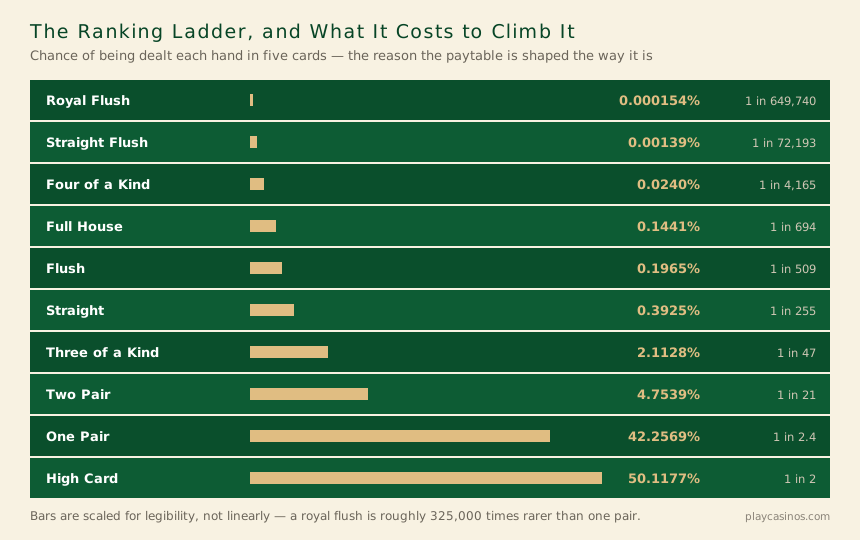
Why the paytable is shaped the way it is: the rarer the hand, the bigger the multiple.
Which Casino Poker Game Has the Best Odds?
Side bets excluded, here is how the casino poker games compare on their main bets with correct play:
Ranked on cost per hand rather than on how they feel to play, the casino poker games split into two camps: the ones where a correct decision changes the maths, and the ones where the paytable has already decided. House edge by game shows how wide that gap gets.
Game
House edge
RTP
Skill involved
Video poker (9/6 Jacks or Better)
0.46%
99.54%
Every hand — hold decision
Casino Hold’em
~2.2%
~97.8%
Call or fold after the flop
Ultimate Texas Hold’em
~2.2%
~97.8%
Raise sizing by street
Pai Gow Poker
~2.8%
~97.2%
Setting two hands
Three Card Poker
~3.4%
~96.6%
One fold/play rule
Caribbean Stud
~5.2%
~94.8%
One raise/fold rule
If odds are all you care about, video poker wins and it is not close. The table games buy you something different: a slower pace, a live dealer, and in Three Card Poker’s case a strategy you can memorize in ten seconds.
Play Casino Poker Free: The Jacks or Better Trainer
The trainer below deals real five-card video poker hands and grades your hold decision against the mathematically correct play on the spot, awarding XP for the right call whether or not the hand ends up paying. It is the fastest way to make correct strategy automatic before any real money is involved.
Casino Poker Questions, Answered
How do you play 3 card poker?
Post an Ante, receive three cards, then fold or make a Play bet equal to your Ante. The dealer qualifies with queen-high or better. The only strategy you need: play queen-six-four or better, fold anything worse.
What happens in Caribbean Stud when the dealer doesn’t qualify?
If the dealer’s five cards don’t reach ace-king or better, your Ante pays even money and your raise pushes back to you, no matter how strong your own hand was. That’s why big hands against a weak dealer board can feel anticlimactic.
What is the Pair Plus bet in Three Card Poker?
A side bet that pays purely on your own three cards, starting at any pair, regardless of what the dealer holds. It plays independently of the Ante and Play bets and carries a higher house edge than the base game on most paytables.
Is video poker the same as casino table poker?
No. Video poker is a machine game played against a fixed paytable with a draw decision; table variants like Three Card Poker and Caribbean Stud are dealt live against a dealer’s hand. Both use poker hand rankings, but the strategies don’t transfer.
How do you play video poker?
You’re dealt five cards, choose which to keep, and discard the rest for a single replacement draw. Your final hand pays according to a fixed paytable if it ranks a pair of jacks or better in the standard variant.
What is a full pay video poker machine?
A machine with the most player-favorable paytable for its variant, such as 9/6 Jacks or Better, referring to the full house and flush payouts per coin at max bet. Short-pay versions look similar but pay less on those same hands.
Which casino poker game has the best odds?
Full-pay 9/6 Jacks or Better video poker, at roughly 0.46% house edge with correct strategy. Among the live tables, Casino Hold’em and Ultimate Texas Hold’em sit near 2.2%, Three Card Poker near 3.4%, and Caribbean Stud around 5.2%.
Do you play against other people in casino poker?
No. Every game on this page is banked by the house: you’re paid from the casino’s money when you win, not from a pot shared with other players. Player-versus-player poker happens in a separate card room under different rules.