Online Casino Games Explained: Every Type, Every House Edge
Walk into any casino, physical or otherwise, and the room is arranged to hide one fact: the games are not equally priced. A blackjack table and the slot machine ten feet away take money at rates that differ by a factor of eight, and nothing about the lighting, the carpet or the drinks service tells you which is which.
This page is the map. Every family of casino game, what each one actually costs to play, which ones reward a decision and which ones simply do not, and where each sits on the floor plan of this site. If you want to skip the theory and sit down, the five rooms are linked throughout.
4Families of casino game0.46%Cheapest game on the floor5.26%Most expensive standard table11×Gap between them
Where to Play These Games for Real Money
Every game above is playable free on this site, with no account and no download. If you move to real stakes, the operator matters for exactly three reasons: whether it is licensed where you live, whether it offers the good version of the game rather than only the bad one, and how quickly it pays.
Asia licenses less online casino play than any other region on this page, so read the market column before anything else. The Philippines is the clear exception: PAGCOR licenses domestic play through its Electronic Gaming Licensing Department, and since the offshore POGO regime was abolished outright a site reachable from inside the country is legal only with a domestic licence and a verifiable PAGCOR seal. The PIGO operators above are integrated resorts, which means their games run on real tables and machines inside the building rather than on a software server. Georgia and Armenia are Western Asia geographically and are licensed by the Revenue Service of Georgia — note that Georgian citizens must be 25, while visiting foreign nationals may play from 18. Most of the rest of the region licenses nothing: India banned real-money online gaming outright in 2025, and China, Indonesia, Vietnam, Thailand, Japan and South Korea all prohibit or heavily restrict online casino play for residents.
*Bonus figures are indicative and change often — always confirm the current offer and the full T&Cs on the operator’s own site. Minimum age 18–25 depending on jurisdiction — 21 across the United States and the Philippines, and 25 for Georgian citizens. Play only where it’s legal for you, and only what you can afford to lose — support is at BeGambleAware.org and your local helpline.
The Four Families of Casino Game
Almost everything in a licensed lobby belongs to one of four groups. The grouping is not decorative: each family behaves differently on the three things that decide what a session costs you, which are the house edge, the speed of play and whether your decisions change the outcome at all.
Slots
RTP 92–98% · no decisions
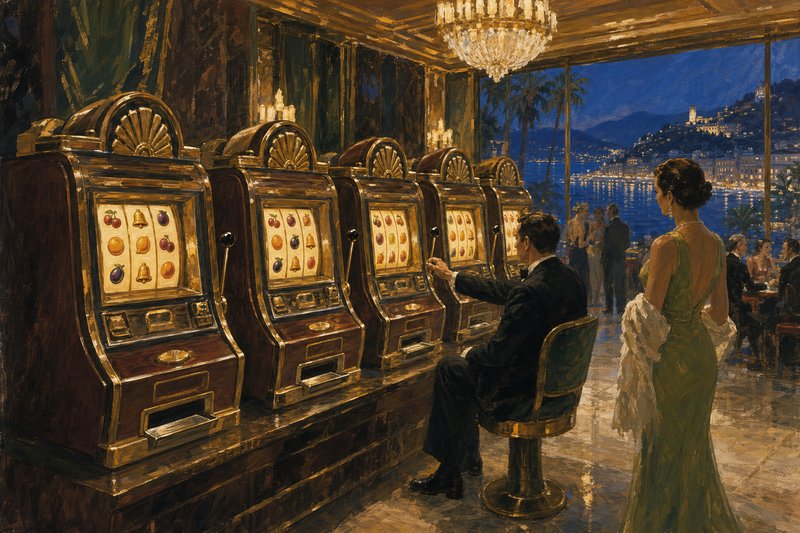
Reels, paylines and a random number generator. The largest family by a wide margin, typically seventy to eighty percent of any online lobby, and the only one where the machine resolves entirely without you.
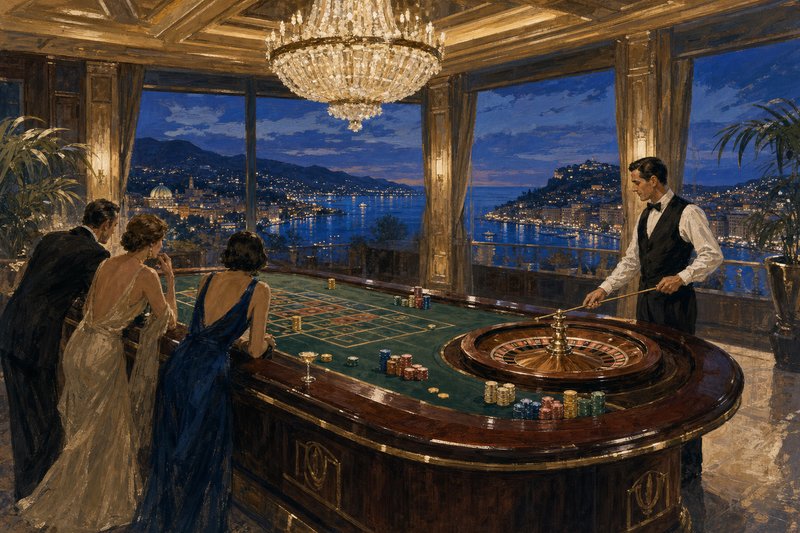
Roulette and baccarat: a wheel or a shoe, a layout, and a bet placed before anything happens. No skill after the chips are down, but an enormous spread between the good bets and the bad ones.
Bet selection is the entire strategy
Single-zero roulette costs half what double-zero does
Baccarat banker is the second-cheapest bet on the floor
Blackjack, the house-banked poker variants and video poker. The only family where playing well and playing badly produce measurably different results, and the only one with a published correct answer for every situation.
Blackjack: four decisions, one chart, 0.5% edge
Three Card Poker, Caribbean Stud, Casino Hold’em
Full-pay video poker returns 99.54% to correct play
The fourth family is the one this site does not build tables for: keno, bingo, scratchcards and the instant-win games. They are simple, they resolve in seconds, and as a group they carry the highest house edge in the building, commonly eight to twelve percent and occasionally far worse. There is no strategy content to write about them because there is no strategy. That is the entire review.
Live-dealer tables are not a fifth family. They are the table and card games above, streamed from a studio with a human dealer, and the odds are identical to the software versions. What changes is the pace, which is slower, and the minimum, which is usually higher.
What Each Game Actually Costs Per Hour
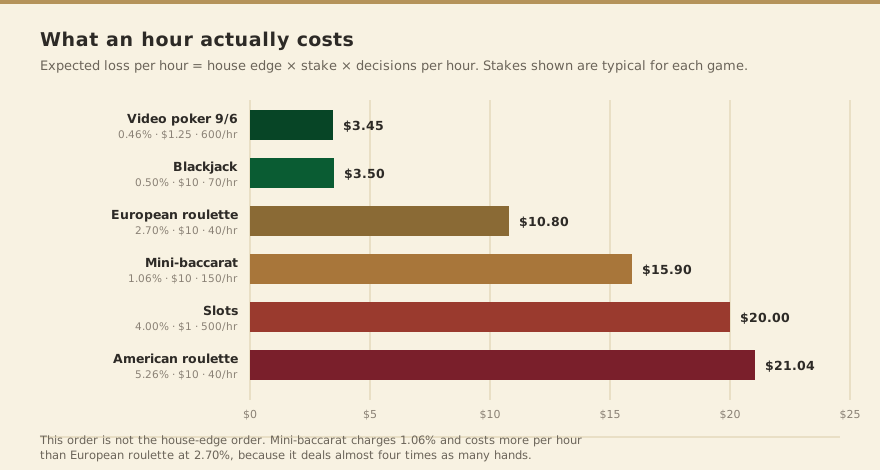
House edge is a rate, not a price. Quoting it alone is how the industry makes a 4% slot sound worse than a 5.26% roulette wheel when in practice they cost about the same, because one of them takes five hundred decisions an hour and the other takes forty.
The honest number is expected loss per hour, which is the house edge multiplied by your stake multiplied by how many times the game resolves. Here it is, at stakes that are realistic for each game rather than artificially matched.
The order here is not the house-edge order, because speed and stake do most of the work.
Two things fall out of that chart. Mini-baccarat charges 1.06%, less than half what European roulette charges, and still costs more per hour, purely because the dealer gets through roughly four times as many hands. And slots, at a modest one dollar a spin, land within a dollar of an American roulette wheel taking ten times the stake per decision.
If you want to spend less per hour without playing worse games, the lever that moves most is not the game. It is the number of decisions you take. A live-dealer table with a human shuffling is not a worse deal than its software equivalent; it is the same deal, delivered a third as often.
The Four Terms Everything Else Assumes You Know
House edge
The share of every bet the casino expects to keep over the long run, expressed as a percentage of the amount wagered. A 2.7% edge means that of every $100 staked, the house expects to keep $2.70. It says nothing about any individual session.
RTP
Return to player, the same figure inverted: 100% minus the house edge. Slots are quoted in RTP, table games in house edge, for no reason other than convention. A 96% RTP slot has a 4% house edge.
Volatility
How lumpy the returns are. Two slots can both pay 96% while one drips small wins constantly and the other pays nothing for two hundred spins and then everything at once. Volatility does not change the cost, only how long your money survives while you find out.
RNG
The random number generator that decides every slot spin and every software card. It is tested and certified before the game goes live, it has no memory of the last spin, and no mechanism exists for it to tighten after a payout. Certification bodies you will see named are GLI, eCOGRA and iTech Labs.
Blackjack: The One Where Your Decisions Count
Four decisions per hand, one published correct answer for each of them.
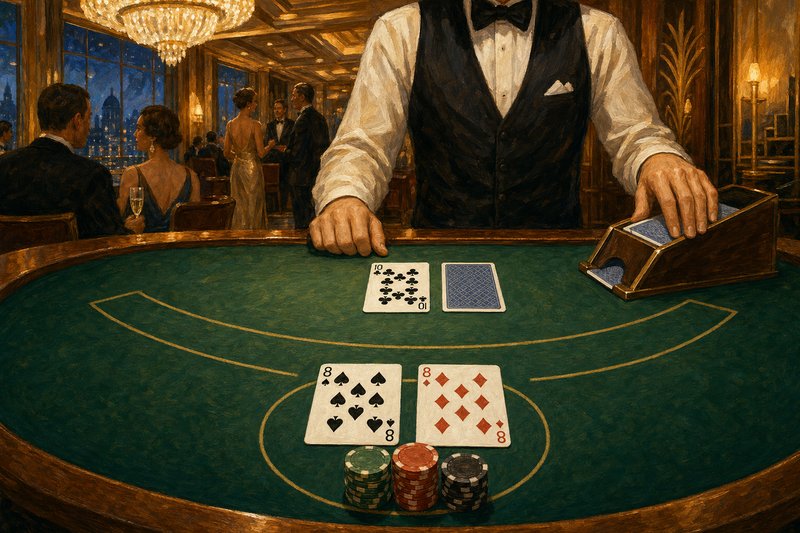
Two cards each, a dealer who must follow a fixed rule, and a target of twenty-one without going over. It is the only game on the floor where playing well and playing badly produce measurably different results over a year, because every hand hands you a real decision — hit, stand, double or split — and every one of those decisions has a published correct answer.
Played to that answer on a decent rule set, the house keeps about 0.5% of what you stake. Played on instinct, the same table costs two to three times more. The gap is entirely the chart, which takes an evening to learn and is the highest-value hour on this whole site. Rules matter almost as much: a table paying 6:5 on a natural instead of 3:2 quietly adds well over a percentage point, and no amount of correct play recovers it.
One green pocket is the entire house edge. A second one doubles it.
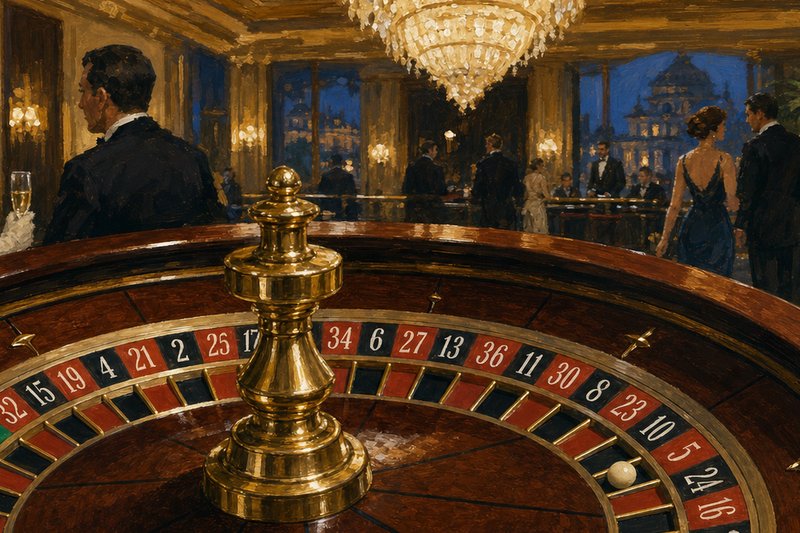
A number comes up and either your chips were on it or they were not. There is no decision after the bet is placed, which makes roulette the purest chance game in the building and the one most surrounded by systems that do not work. What roulette does reward is knowing which wheel you are at.
A single-zero European wheel charges 2.70% on essentially every bet. An American wheel with its extra double-zero pocket charges 5.26% for an identical-looking game — nearly double, for one green slot. A French wheel is better still: the la partage rule returns half your stake on an even-money bet when zero lands, which cuts the edge on red-black and odd-even to 1.35%, the best number available on any wheel anywhere.
Where to go next: the roulette guide covers every bet type with its true odds and payout, and its free table spins a real 37-pocket wheel you can place inside and outside bets on.
Slots: The Fastest Money on the Floor
The fastest game in the building, which is what makes it the most expensive.
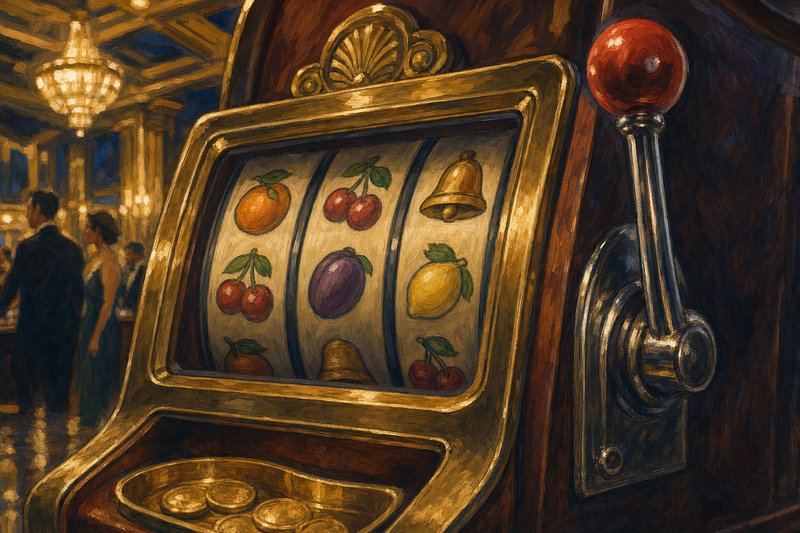
Seventy to eighty percent of an online lobby is slots, and they are the only family where the machine resolves entirely without you. That makes them simple and it makes them expensive, because speed is what actually empties a bankroll: a slot resolves four to six hundred times an hour against forty for a live blackjack table.
Two numbers describe a slot and only one of them is advertised. RTP is what it returns over the long run, usually 92% to 98%, and the same title often ships in several configurations — the operator picks which one you get, so the figure in the game’s info panel is the only one that applies to you. Volatility describes how lumpy the ride is; it does not change the cost, only how long your balance survives while you find out.
Where to go next: the slots guide explains how to read both numbers before you spin, and the software studios page explains why the same slot can pay several percentage points less at one casino than another.
Casino Poker: One Decision, Or a Real Skill
One memorised rule for most of the family — and a real skill in video poker.
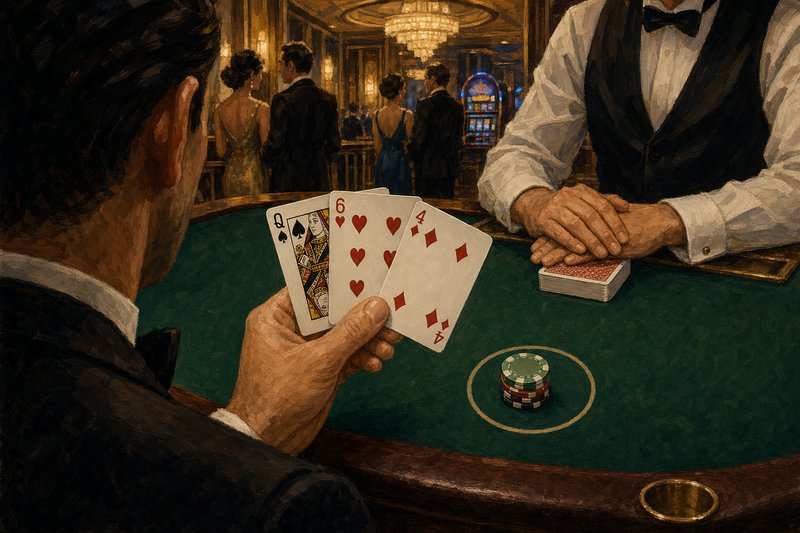
Poker at a casino is not the poker played against other people. It is the house-banked family — Three Card Poker, Caribbean Stud, Casino Hold’em, Ultimate Texas Hold’em — where you play a fixed paytable rather than a table full of opponents, and most of them come down to a single memorised rule. Three Card Poker is the clearest example: raise on queen-six-four or better, fold everything else, and you have played it correctly forever.
Video poker is the outlier and the reason this family is worth your attention. A full-pay 9/6 Jacks or Better machine, played with correct discards, returns 99.54% — a house edge of 0.46%, the cheapest game in the building, cheaper even than blackjack. The catch is the paytable: an 8/5 short-pay machine looks identical on the cabinet and costs several times more.
Where to go next: the casino poker guide covers every house-banked variant and includes a video poker trainer that grades your discards against the optimal hold.
Baccarat: The Cheapest Game That Asks Nothing
Nothing to learn, nothing to get wrong, and the second-cheapest bet on the floor.
Two hands are dealt, Player and Banker, and you bet on which will finish closer to nine. The drawing rules are fixed and the dealer applies them for you, so there is genuinely nothing to learn and nothing to get wrong — which is exactly why it suits an evening where you do not want to think.
The maths is unusually clean. Banker carries a 1.06% edge even after the 5% commission on wins, Player is close behind at 1.24%, and the Tie is a trap at over 14% — the widest gap between two bets on any single table in the casino. Banker, every hand, is the entire strategy. The big table is also pleasantly slow, which makes it cheaper per hour than its edge suggests.
Where to go next: the baccarat guide walks through the third-card rules, the commission maths and why the tie bet stays on the felt purely because people keep taking it.
Ordered by cost. The two cheapest are the two that ask something of you, which is not a coincidence.
Which Casino Game Actually Suits You
“Best game” is the wrong question, because the honest answer is always video poker at a full-pay machine and almost nobody wants to play that. The useful question is which game fits what you came for.
You want the cheapest hour
Cost per hour is the only thing you care about, and you are willing to learn something to get it.
Blackjack at a 3:2 table, using the chart. Around $3.50 an hour at $10 a hand, and the chart takes an evening to learn.
You want to make decisions
The appeal is the thinking, not the spinning. You want a game where being good at it means something.
Video poker, full-pay only, or Casino Hold’em. Both have a published correct play for every hand and punish guessing.
You want to switch off
No decisions, no chart, no pressure to be good at anything. Just something to do with a drink in your hand.
Baccarat, banker every time. It is the lowest-cost game that asks nothing of you, at 1.06%, and the big table is pleasantly slow.
You want the big number
You accept the cost because the point is the small chance of something absurd happening.
Progressive slots, at a stake you would not miss. Understand that the base game pays back less to fund the jackpot you are buying a ticket for.
Five Things That Are Not True
A machine that has not paid out is due.Every spin is independent. A slot that has paid nothing for four hours has exactly the same chance on the next spin as it did on the first. The gambler’s fallacy is the single most expensive belief in the building.
Casinos tighten the machines at busy times.The RTP configuration of a licensed game is fixed and certified, and changing it requires taking the game offline and re-certifying. What varies is which configuration the operator licensed in the first place, and that is checkable in the game info panel.
Betting systems beat the house edge.Martingale, d’Alembert, Fibonacci and the rest all redistribute when you lose, not whether. They trade a high chance of small wins for a small chance of a catastrophic one, and the table maximum exists specifically to close the loop.
The dealer’s previous cards tell you something.In a continuously shuffled or software game, no. In a hand-dealt shoe they do, marginally, which is exactly why casinos moved to six and eight decks and continuous shufflers in the first place.
A bonus is free money.A welcome bonus is priced to be profitable, and the price is the wagering requirement. A 35× requirement on $100 means $3,500 of turnover, usually on games with the largest edge, before any of it is yours.
Every figure on this page describes optimal or basic-strategy play where a strategy exists, and standard rule sets otherwise. To put a number against a specific table, use the RTP and house edge database; to see which licensed operators carry the good version of each game, the casino register is ranked by payout speed.
Questions About Casino Games
Which casino game has the best odds?
Full-pay 9/6 Jacks or Better video poker, at a house edge of 0.46% to a player using correct strategy. Blackjack with good rules is next at around 0.5%, and baccarat’s banker bet is third at 1.06%. The catch with video poker is that the machine has to be full pay, and most are not.
What is the difference between house edge and RTP?
None, mathematically. They are the same figure expressed from opposite ends: RTP plus house edge always equals 100%. Slots are quoted in RTP and table games in house edge purely by industry convention.
Are online casino games rigged?
At a licensed operator, no, and the reason is structural rather than moral: the random number generator is certified by an independent lab before launch, and the house edge already guarantees a profit without any interference. Rigging a game the casino already wins would risk a licence for no additional return. At an unlicensed site none of that applies.
Which casino game is easiest for a beginner?
Baccarat, because there is nothing to learn. You pick banker or player and the fixed drawing rules handle everything else, at a house edge better than roulette. If you want a game with decisions, Three Card Poker has exactly one rule worth memorising: raise on queen-six-four or better.
Do live dealer games have different odds than software games?
No. A live blackjack table and a software blackjack table with the same rules carry the same house edge. What differs is speed, and that changes your hourly cost substantially: a live table might deal 40 hands an hour against 200 for the software version, which makes the live table roughly five times cheaper per hour at the same stake.
Can I play these casino games for free?
Yes. Every game family covered here has a free table on this site, running in the browser with no download and no account. The blackjack and video poker trainers grade each decision against correct strategy rather than against whether the hand won, which is the part a real casino will never tell you.
House edge and RTP figures on this page describe optimal or basic strategy play where a strategy exists, and standard rule sets otherwise. Individual tables and titles vary; the game information panel at a licensed operator is the authority for any specific game. See the RTP and house edge database for the full table, or how we test.