How to Play Roulette: Odds, Strategy and a Free Practice Table
The ball drops, bounces twice off a diamond deflector, and lands. Nothing about which number it hits depends on anything that happened three spins ago, which is precisely the part most new players refuse to believe.
Roulette is the purest chance game on the floor, and understanding how to play roulette well means understanding the bets, not chasing a pattern that isn’t there. These roulette rules for beginners and the odds behind them are the whole game, nothing hidden beyond that.
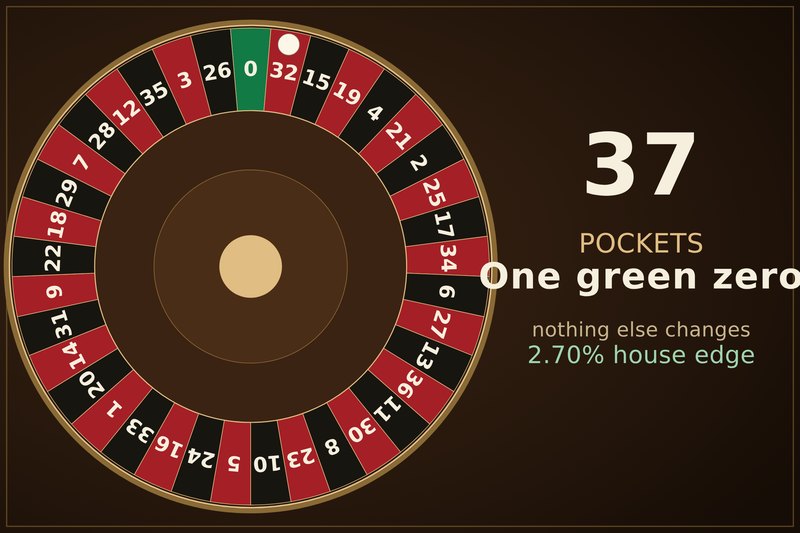
2.70%House edge, single-zero wheel37Pockets on a European wheel35 : 1Straight-up payout
How to Play Roulette: Rules for Beginners
You place chips on a betting layout before the dealer spins the wheel and releases the ball in the opposite direction. Once the ball settles in a numbered pocket, winning bets pay according to the odds for that bet type, and everything else is swept clean.
Betting continues on a fresh spin with no memory of the last one. If you are still deciding what to play at all, the casino games map compares roulette against the other families by cost per hour. That’s really all there is to how to play roulette at the table level; the rest is just knowing which bets pay what.
These roulette rules for beginners stay identical whether you’re at a $5 table or a high-limit one; only the minimum and maximum bets actually change between them.
If you’re learning how to play roulette for the first time, the betting layout looks more intimidating than it actually is: every box on the felt corresponds to exactly one payout, printed on the table itself, so there’s nothing to memorize beyond recognizing the boxes.
Where to Play Roulette for Real Money
Practice on the free wheel further down this page costs nothing and behaves identically to a real one. If you move to real money, the single thing worth checking before you deposit is whether the casino offers single-zero tables at the stake you want to play, because the difference between wheels is larger than any difference between operators.
These are the licensed casinos we have reviewed, listed by region, with what each one is actually good for at the roulette table.
Roulette Rooms Worth Your Chips
Licensed operators with live and RNG wheels, by region.
Asia licenses less online casino play than any other region on this page, so read the market column before anything else. The Philippines is the clear exception: PAGCOR licenses domestic play through its Electronic Gaming Licensing Department, and since the offshore POGO regime was abolished outright a site reachable from inside the country is legal only with a domestic licence and a verifiable PAGCOR seal. The PIGO operators above are integrated resorts, which means their games run on real tables and machines inside the building rather than on a software server. Georgia and Armenia are Western Asia geographically and are licensed by the Revenue Service of Georgia — note that Georgian citizens must be 25, while visiting foreign nationals may play from 18. Most of the rest of the region licenses nothing: India banned real-money online gaming outright in 2025, and China, Indonesia, Vietnam, Thailand, Japan and South Korea all prohibit or heavily restrict online casino play for residents.
*Bonus figures are indicative and change often — always confirm the current offer and the full T&Cs on the operator’s own site. Minimum age 18–25 depending on jurisdiction — 21 across the United States and the Philippines, and 25 for Georgian citizens. Play only where it’s legal for you, and only what you can afford to lose — support is at BeGambleAware.org and your local helpline.
European vs American Roulette
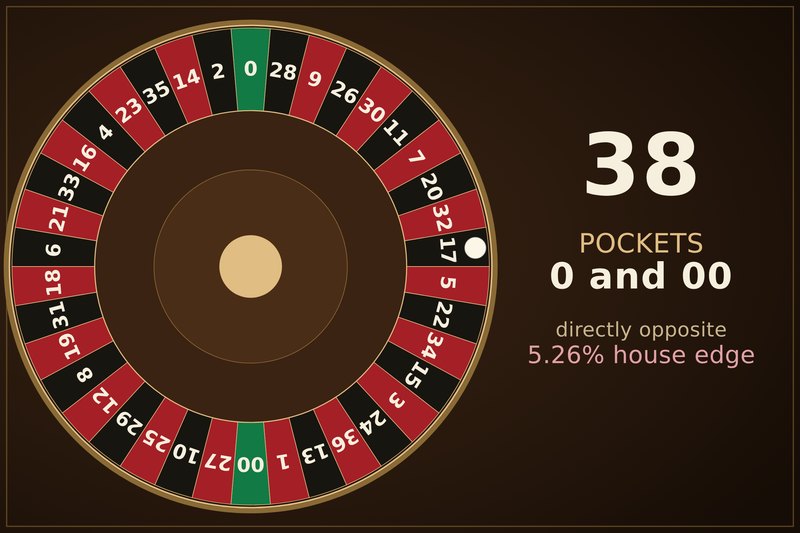
European wheels carry 37 pockets, numbers 1 through 36 plus a single zero. American wheels add a second green pocket, 00, bringing the total to 38. The gap between European vs American roulette comes down entirely to that one extra pocket, nothing else on the wheel changes.
That one pocket nearly doubles the house edge, from 2.7% on a European wheel to 5.26% on an American one, on every bet except one obscure five-number wager unique to American tables.
If a casino offers both wheel types, the European wheel is mathematically the better game, full stop, with no exceptions worth chasing. The European vs American roulette question isn’t a style choice at all, it’s a fixed 2.5-point swing in the house edge, full stop.
The Three Roulette Versions You Will Meet Online
Every roulette table in a licensed casino descends from one of three layouts. They look nearly identical across the room. They are not remotely the same bet, and the gap between the best and worst of them is a factor of four on even-money wagers.
European
House edge 2.70%
Thirty-seven pockets: one through thirty-six plus a single green zero. This is the default wheel across Europe, Latin America and most online lobbies, and it is the baseline every other version is measured against.
37 pockets, one zero
Straight-up pays 35:1 against true odds of 36:1
Same 2.70% edge on every bet on the table
The sensible default. If a casino offers this and an American wheel, there is no argument.
American
House edge 5.26%
One extra green pocket, the double zero, and thirty-eight in total. Nothing else about the wheel or the payouts changes, which is exactly why the extra pocket is so expensive: the odds against you rise and the payout does not.
38 pockets, zero and double zero
Straight-up still pays 35:1 against true odds of 37:1
The five-number bet is worse still, at 7.89%
Nearly twice the cost of a European wheel for an identical experience. Avoid it.
French
Even-money edge 1.35%
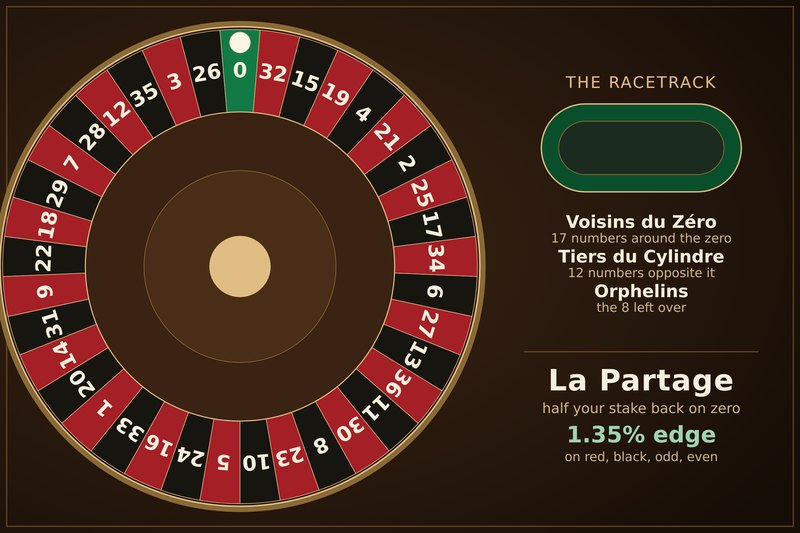
A single-zero wheel with one extra rule attached: when the ball lands on zero, an even-money bet is not simply lost. Under la partage you get half your stake back; under en prison it stays on the table for one more spin.
Same 37-pocket wheel as the European game
La partage or en prison halves the zero’s cost on outside bets
Racetrack layout for called bets like voisins du zéro
The best bet in the building on red, black, odd or even. Genuinely worth seeking out.
One caveat on the French table: the reduced edge applies only to the even-money outside bets. Put a chip straight up on 17 at a French wheel and you are paying the same 2.70% you would at any single-zero table. La partage refunds half a losing even-money stake on zero, and a straight-up bet was never an even-money stake.
Live-dealer lobbies muddy the naming. Tables branded Lightning, Immersive or Speed are almost always European wheels with a presentation layer on top, though Lightning-style games take a cut from the straight-up payout to fund their multipliers, pushing the edge on those bets closer to 5%. Check the paytable, not the name.
Inside Bets vs. Outside Bets
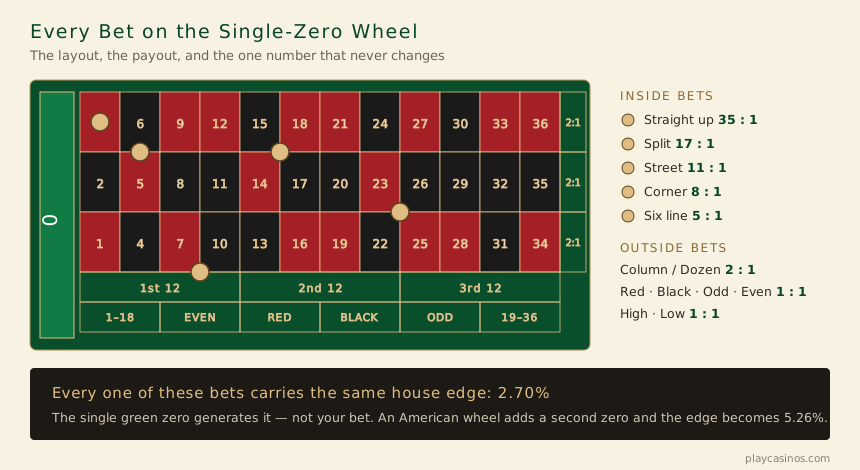
Inside bets are placed directly on numbers: a straight bet on a single number pays 35:1; a split (two adjacent numbers) pays 17:1; a corner (four numbers) pays 8:1. Outside bets cover broader categories instead, and pay accordingly less for the higher hit frequency they offer.
Red or black, odd or even, and high or low all pay even money; dozens and columns, covering 12 numbers each, pay 2:1. The house edge is identical across nearly every bet on a given wheel, so the real choice here is about variance, not expected value. Our RTP and house edge database puts that 2.7% next to every other game on the floor.
Every bet on a single-zero wheel pays differently and costs the same: 2.70%.
Roulette Payout Chart and Odds
This roulette payout chart covers a European wheel: a straight-up bet on a single number pays 35:1 and hits roughly 1 in 37 spins, while an even-money bet like red/black pays 1:1 and hits roughly 18 in 37 spins.
Nothing in that table changes between casinos, because the payouts are fixed by the bet rather than by the house. What changes is the wheel, which is why how to play roulette matters far less to your bankroll than which version you sit down at. The house edge for every game puts that difference in numbers.
The house edge stays at 2.7% across every standard bet on this roulette payout chart, since the single zero is what creates the house’s advantage regardless of which numbers you personally back.
Roulette payout chart, single-zero wheel
Bet
Numbers covered
Pays
Win chance
Straight up
1
35 : 1
2.70%
Split
2
17 : 1
5.41%
Street
3
11 : 1
8.11%
Corner
4
8 : 1
10.81%
Six line
6
5 : 1
16.22%
Column or dozen
12
2 : 1
32.43%
Red, black, odd, even, high, low
18
1 : 1
48.65%
Notice the last column never reaches 50% — that gap is the zero, and it is the entire house edge.
The Martingale Betting Strategy: Does It Work?
The Martingale system doubles your bet after every loss on an even-money wager, the idea being that a single eventual win recovers all previous losses plus a small profit on top. It doesn’t beat the house edge, though, for one specific reason.
Table maximum limits and your own bankroll both cap how many times you can actually double before either one runs out, and a long losing streak is far more common than intuition suggests. It’s a betting pattern, not a strategy that changes the underlying math at all.
Why Every System Fails
the three claims you’ll meet, and what’s wrong with them
“Double after a loss and you can’t lose.” You can — the table limit stops you before the recovery bet is legal.
“Red is due after six blacks.” The wheel has no memory. The next spin is 48.65% either way, as always.
“Bet the numbers that are running hot.” On a maintained wheel there are none; on a biased one the casino finds it before you do.
Play Roulette Free: Try the Wheel
The table below spins a real European wheel with no download and no time limit, so you can place inside and outside bets and watch how the payouts and odds actually play out before ever risking real money. A free strategy note worth remembering: no betting strategy changes those odds, only how your bankroll swings while you’re exposed to them.
Practising costs nothing here, and it is the quickest way to turn how to play roulette from something you have read into something your hands do without prompting.
Roulette Questions, Answered
How do you play roulette?
Place chips on the betting layout before the wheel spins, then wait for the ball to land in a numbered pocket. Winning bets pay according to fixed odds for that bet type, and a new round starts with no memory of the last spin.
What’s the difference between European and American roulette?
European wheels have a single zero and a 2.7% house edge; American wheels add a second zero (00), pushing the house edge to 5.26% on nearly every bet. The European wheel is the better game whenever you have a choice.
What are inside and outside bets in roulette?
Inside bets are placed on specific numbers and pay higher odds for lower hit frequency; outside bets cover broader categories like red/black or odd/even and pay lower odds for higher hit frequency.
What is the house edge in roulette?
2.7% on a European (single-zero) wheel and 5.26% on an American (double-zero) wheel, applying to nearly every standard bet type on each respective wheel.
Can you bet on 0 in roulette?
Yes, a straight bet directly on the zero pays the same 35:1 as any other single-number bet on a European wheel, and both zero pockets are individually bettable on an American wheel.
Does the Martingale betting system work in roulette?
No. Doubling your bet after every loss doesn’t change the underlying house edge, and table betting limits combined with real-world bankroll limits eventually cap how many times you can double.
What is the safest bet in roulette?
Even-money outside bets like red/black or odd/even hit most often, though the house edge is the same across nearly every bet type on the wheel. “Safest” here means smaller swings, not better long-run odds.
What does the roulette table layout look like?
A grid of numbers 1 through 36 in three columns, alternating red and black, with the zero (and 00 on American tables) at one end, surrounded by boxes for the outside bets like dozens, columns, and even-money wagers.
Are there roulette rules for beginners that differ from expert play?
No. The rules and odds are identical regardless of experience level; what improves with practice is table comfort and bankroll management, not the underlying math of any bet.